News, reviews and information for fans of crime fiction set in Italy
A good detective story taking place in a beautiful part of Italy is a real treat for people who enjoy reading crime mysteries and also happen to love Italy. Use this website to find out more about the locations, the lifestyle and the food and the wine experienced by the characters created by your favourite authors.
A crime mystery set in Rome served up with lashings of Italian culture
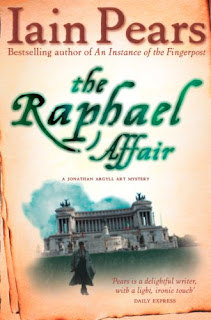
The Raphael Affair is the first of a series featuring Jonathan Argyll
This first novel of an Italian art history mystery series will delight many people who enjoy crime fiction with Italy as the backdrop.
Written by Iain Pears, an English art historian, novelist and journalist, The Raphael Affair introduces British art dealer Jonathan Argyll, who becomes a series character. He is brought to the attention of an Art Theft officer working for the Italian police, Flavia di Stefano, when he is caught breaking into a church in Rome.
A graduate student on holiday in Italy, Argyll had been arrested for vagrancy when he was found apparently trying to sleep in the church of Santa Barbara in the Campo dei Fiori.
When Flavia interviews him in English, she discovers that Argyll had gone to the church to examine a painting by Raphael that was hanging above the altar. He insists on making a full statement because he is convinced an enormous fraud has taken place.
He claims that the church contains a lost classic, hidden under another painting. When the picture vanishes, only to turn up in the hands of a British art dealer who claims it is a newly-discovered work by Raphael, his story gains some credibility.
Argyll and Flavia di Stefano join forces to find out whether the painting is a lost Raphael or not, but find themselves in danger when they come too close to discovering the truth.
Iain Pears has worked in Italy as a journalist
The Raphael Affair, which was first published in 1990, is a well-plotted story by Pears with sympathetic characters and its fair share of politics, corruption, suspense and sudden death. The outcome is surprising and sets up Argyll nicely to stay in Italy, see more of Flavia and appear in another novel.
Author Iain Pears was born in Coventry and educated at Oxford. He became a reporter for the BBC and then a correspondent for Reuters based in Italy, France and the US.
Following The Raphael Affair, Pears has published another six art mystery novels featuring art historian Jonathan Argyll. They are: The Titian Committee, The Bernini Bust, The Last Judgment, Giotto’s Hand, Death and Restoration and The Immaculate Deception.
I don’t know why it has taken me so long to read The Raphael Affair, but now I can’t wait to get started on The Titian Committee!
An Inspector Montalbano Mystery by Andrea Camilleri
Montalbano locates the scene of the crime by following a trail of hoofprints in the sand
Inspector Montalbano finds himself distracted by a beautiful, female equestrian champion and also distraught when events conspire to prevent him enjoying good food, in this 12th book in the series.
The Inspector’s troubles begin when he finds the carcass of a dead horse on the beach in front of his house. When he gets close to it, he is overcome with rage. ‘The beast was all bloodied, its head broken open with some sort of iron bar, its whole body bearing the signs of a long, ferocious beating. There were deep, open wounds, pieces of flesh dangling. It was clear that the horse, battered as it was, had managed to escape and run desperately away until it could go no further.'
Montalbano follows the hoofprints to the spot where the horse had been beaten and discovers from the impressions in the sand that four people had been hitting the horse with iron bars, witnessed by two others, who had stood to one side, smoking.
He calls out his men and sends them to scour the beach for forensic evidence and then rings up City Hall to arrange for the carcass to be taken away. But while he and his men are having coffee in the house, the horse mysteriously vanishes, leaving only a track in the sand.
The Track of Sand is the 12th of Camilleri's Montalbano novels
Before long, Rachele, a glamorous horsewoman, turns up at police headquarters to report her horse missing. It had been stabled in the grounds of one of the richest men in Sicily, who had lost one of his horses as well.
Even though the case really belongs to officers working in another part of the island, Montalbano can’t resist investigating himself and he vows to track down the people responsible for this atrocity.
But it soon becomes obvious that he has upset someone, as thieves break into his home twice, once to steal a watch and once to put it back.
Coincidentally, Rachele is staying with Montalbano’s attractive Swedish friend, Ingrid, and the two women ask Montalbano to go with them to a fund-raising dinner, which, of course, he dreads. He knows in advance that the food will be awful and finds he is absolutely right. He returns home late at night looking forward to eating olives and anchovies from the fridge with some hard bread and plenty of wine. But he finds his house has been ransacked while he was out.
Montalbano and his officers work hard to unravel the mystery, track down the guilty parties and arrest them.
Then the Inspector races home to set the table on his veranda so he can sit down and enjoy a meal cooked by his housekeeper, Adelina, for himself, Ingrid and Rachele. He intends to savour the food, before explaining everything to them...
I am sure new readers and seasoned Camilleri fans alike will enjoy this 12th serving of Montalbano’s unorthodox investigative methods, melancholy self-reflection, Sicilian humour and perfectly cooked fish, all beautifully translated by Stephen Sartarelli.
The first
Inspector De Vincenzi mystery by Augusto De Angelis
Augusto De Angelis's mystery The Murdered Banker is set in the Milan of the 1930s
The Murdered
Banker is a highly significant novel in the history of Italian crime fiction as
it is the first detective story written by Augusto De Angelis, who is regarded
by many as the father of the genre in Italy.
First
published in 1935 in Italian as Il banchiere assassinato, the novel
appeared at the peak of the British Golden Age of detective fiction, six years
after Italian publishers Mondadori had launched their crime series in yellow (giallo) covers that would later result in the word gialli being used to refer to
mystery novels and films.
There were
no Italian authors on the first Mondadori list as the publishers did
not see Italy as the right setting for the crime genre at that time.
However, journalist
De Angelis did not agree, as he thought crime fiction was a natural result and
product of the fraught and violent times he was living in and writing about.
To begin
with, Mussolini and his associates approved of the crime fiction genre because
it celebrated the achievements of the forces of order over evil and chaos by
bringing about just solutions and restoring tranquillity. However, they eventually
became wary of Italy being seen to be anything less than idyllic by the outside
world.
The Pushkin Vertigo edition of The Murdered Banker
The Murdered
Banker was the first of 20 novels by De Angelis featuring Inspector De Vincenzi,
which he produced over just eight years. De Angelis had a unique style and created a
detective who could not have been more different from the eccentric and clever
Sherlock Holmes and the methodical little Belgian, Hercule Poirot.
De Angelis
is therefore seen as the father of Italian crime fiction. It is interesting to
see how many of the traits of his protagonist have appeared in fictional
Italian detectives since. De Vincenzi’s loyalty to his friends and care for his
subordinates made me think of Donna Leon’s Brunetti. His disregard for the
rules, unorthodoxbehaviour and moments
of inspiration also made me think of Michael Dibdin’s Zen and Andrea Camilleri’s Montalbano.
The story
starts on a foggy night in Milan, when De Vincenzi is on the night shift and is
visited at his police station by an old schoolfriend, Giannetto Aurigi. While
he is talking to his friend, who is clearly worried about something, he
receives a call about a body being discovered in a house nearby and when he is
given the address is horrified to discover it is in his friend’s apartment.
He goes on
to discover that Aurigi owes a lot of money, which was due to be repaid that
night, and that the dead body is that of the banker who lent it to him.
De Vincenzi feels he doesn’t just have to solve the crime, he has to prove his old friend is
innocent of it and he has to do it quickly before the investigating magistrate becomes
involved. He tells his friend that he has to tell him everything, or he could
soon be facing the firing squad, but Aurigi just keeps repeating that he
doesn’t know anything.
De Angelis wrote 20 Inspector De Vincenzi novels in just eight years
Fortunately,
there are plenty of other suspects, such as Aurigi’s beautiful fiancée, his
future father-in-law, Count Marchionni, and the mysterious tenant living in the
apartment above. De Vincenzi is determined to get to the truth and he lays a
clever trap for the murderer.
Having
visited Milan on many occasions, it was fascinating to read a novel set in the
city in the 1930s, when gentlemen wore evening dress when they were out at
night and treated La Scala almost like a club, where people in society could visit
each other in their boxes during the opera.
The cultured
and often emotional detective De Vincenzi became very popular with Italians, but the Fascist government considered his
creator to be their enemy. De Angelis was arrested and imprisoned in 1943
accused of being anti-Fascist. He was released after three months, but was soon
tracked down by a Fascist activist who beat him up so badly, the writer died of
his wounds in 1944.
An English
translation of The Murdered Banker by Jill Foulston was published by Pushkin Vertigo in 2016.
Hard-drinking investigator from Munich proves to be more erratic than Etna
Mario Giordano's mystery begins with a body on a Sicilian beach
Auntie
Poldi, a larger-than-life character and amateur sleuth, takes centre stage in
this debut crime novel by German writer Mario Giordano.
Recently
widowed, Poldi leaves her native Munich for Sicily where she has every
intention of drinking herself comfortably to death in front of a sea view.
But fate
intervenes when Poldi finds the body of her odd job man, Valentino, lying on
the beach with his face blown away. She promises him there and then that she
will find his killer and avenge his death and sets out to investigate, making
some new friends, but also some enemies, along the way.
Sicily and
the Sicilians provide a colourful backdrop for the novel and there is plenty of
discussion about the island’s culinary specialities, such as who cooks the best
pasta al nero di sepia and canoli alla crema di ricotta, and where to find the
best oyster mushrooms and marzipan fruits.
Poldi also
finds romance with the handsome Commissario Montana, with whom she forms an
uneasy investigative partnership. She puts her own life in danger in order to
find Valentino’s killer, spurred on by the extra incentive of wanting to solve
the case before Montana.
Auntie Poldi
and the Sicilian Lions is the first crime novel by the novelist and screenplay
writer Mario Giordano. Born in Munich in 1963, Giordano studied psychology at
the University of Dusseldorf and now lives in Cologne. The very readable
English translation of the novel is by John Brownjohn.
Auntie Poldi
and the Sicilian Lions was first published in the UK in 2016 by Bitter Lemon
Press and is the first of a crime series featuring the same character.
A tale of
dark deeds carried out against a backdrop of incredible beauty
Authors are
praised by reviewers and readers if they describe the locations of their novels
well, especially if they have chosen a famous city that is familiar to many
people.
I have enjoyed
many good novels set in Florence, but I don’t think I have ever appreciated the
way an author has portrayed the city quite as much as I did while reading A Party
in San Niccolò.
A Party in San Niccolò is a crime novel set in Florence
Christobel
Kent brings Florence to life in the novel and she reawakened many of my own memories
of the city, reminding me that I also once went for an afternoon snack at Procacci in the Via de’ Tornabuoni and of the time when I first saw the Boboli gardens.
In A Party
in San Niccolò, a young
English woman, Gina, visits Florence for the first time and we see the city through
her eyes. She is going to stay with an old friend, Jane, needing a rest from
the demands of her husband and three young children.
Jane’s
marriage to a handsome Italian architect, Niccolò, turns out not
to be as perfect as it
first seems and Gina also finds herself becoming involved in the problems of one of Niccolò’s daughters,
Beatrice, who comes home in a state of shock after learning that her best
friend has been found dead.
When Gina
goes to Niccolò’s country villa
for a few days, she makes an unpleasant discovery and soon finds herself in the
midst of a murder investigation in the Tuscan countryside. She is helped by an
English friend of the family, Frank, and although she is happily married, Gina
finds herself drawn to him.
Throughout
the whole novel we are told about a party due to happen at the end of the week
to celebrate the birthday of Frances, one of the British expats in Florence.
As Gina and
Frank uncover more evidence about the murder of Beatrice’s friend, the night of
the party draws closer. Matters come to a head in a dazzling denouement as the
characters meet up at the party, held in a beautiful garden in Florence that is
evocatively described by Christobel Kent.
A Party in
San Niccolòwas Christobel Kent’s debut novel and
was first published in 2003.
A Chief Superintendent Michele
Ferrara novel by Michele Giuttari
Giuttari's novels are set in the historic and atmospheric city of Florence
One thing you can rely on in a
Michele Giuttari novel is that Italian police procedure will be accurately
described. It is particularly fascinating for readers who enjoy crime novels
set in Italy to see behind the scenes of an Italian police station and be on
the inside of a major police investigation.
Michele Giuttari is well qualified to
describe the way the Squadra Mobile (Flying Squad) unit of the Florence police
operates as he once headed the unit himself when he was a serving officer in
the Polizia di Stato.
This is the second novel in his
series featuring Chief Superintendent Michele Ferrara and the reader finds out
more about the man behind the job title and his earlier life in Sicily as the
case he is working on involves one of his oldest and dearest friends.
The novel begins with a young girl
found unconscious and scantily dressed in remote countryside in the hills above
Florence. She later dies in hospital and the cause of her death is put down to
a drugs overdose. The hospital staff and some of the police assume she was a
drug addict and probably a prostitute.
Michele Giuttari writes with authority as a former serving police officer
But Chief Superintendent Ferrara is
not so sure. For one thing the girl is very young, possibly between 13 and 15
years old. There is nothing on her body to identify her and no one has reported
her missing.
Ferrara digs deeper and embarks on an
investigation that soon throws up connections with some of the richest and most
powerful people in Florence.
In the meantime, his old friend from
Sicily, bookshop owner Massimo Verga, goes missing while staying on the Tuscan
coast.
Ferrara and his wife, Petra, are
extremely worried about the disappearance of Massimo and therefore Ferrara
hands over the inquiry into the death of the unidentified girl to one of his
colleagues so that he can try to find his friend.
The Carabinieri are handling the case
and are working on the theory that his friend, Massimo, has absconded with his
lover, a rich, beautiful businesswoman, after they have killed her ex-husband.
They resent Ferrara’s interference
and put in a complaint about him, which results in his suspension from duty.
But he is not content to leave the case to the Carabinieri and continues to
investigate unofficially, with the help of his loyal team of officers and his
good friend, Deputy Prosecutor Anna Giulietti.
It is a race against time to find
Massimo before anything happens to him and also to prove he is innocent of the
murder.
But Ferrara finds he is up against
the Mafia and a gang of ruthless Albanian drugs bosses, as well as his own Commissioner, who is
enraged both by his unorthodox behaviour and because he has fallen foul of the
Carabinieri.
A Death in Tuscany is well plotted
and gripping, with the solution to the crimes coming right at the end. The
underlying themes of friendship and loyalty are neatly interwoven with the
action.
A novel set in Venice by celebrated 19th century author Wilkie Collins
The historic Caffè Florian on St Mark's Square features in The Haunted Hotel
Wilkie Collins was an English author known for writing sensation novels, or sensation fiction, which was at the peak of its popularity in the 1860s and 1870s. His 1860 novel, The Woman in White, which has been adapted for numerous theatre, film and television productions, is one of the finest examples of sensation fiction, so called because it was written to play on the nerves and excite the senses of the reader.
However, his 1868 novel, The Moonstone, has been talked of as the first English detective novel as it established many of the ground rules of the genre. There is a detective, Sergeant Cuff, a country house setting, false suspects and a final twist in the plot.
So when I received a copy of The Haunted Hotel as a present recently I wondered how closely it would resemble a detective story, which is my favourite genre. I was also intrigued because a lot of the story takes place in Venice, a city that I love. Collins wrote The Haunted Hotel in 1878, ten years after The Moonstone was published.
Collins lived in Italy for nearly two years with his family when he was in his early teens. He also toured Italy with his friend, the novelist Charles Dickens, in 1853 and he returned to Italy with different friends for several visits during the 1860s and 1870s.
In The Haunted Hotel, the reader might think that the novel will deal with the supernatural, as very early in the book questions are raised about being able to predict the future and about sensing evil in a room.
The story begins with a London doctor being visited by a foreign Countess who is desperate for him to tell her whether she is evil, or insane. She is about to marry a nobleman, Lord Montbarry, but has discovered he was engaged to another woman when he proposed to her. However, the lady has subsequently released him from the engagement.
Wilkie Collins was a contemporary and friend of Charles Dickens
The Countess says she has been assured the other woman did not blame her for the broken engagement as the true course of events had been explained to her. But she says that when she eventually met Lord Montbarry’s former fiancée and was aware of the other woman’s eyes upon her, she turned ‘cold from head to foot’ and experienced great fear.
After the marriage has taken place and the couple have gone away on their honeymoon, the story is told from the point of view of the jilted woman, Agnes. She is perceived by all her friends to be a good, kind and loving person, in contrast with the descriptions of the sinister Countess, with her strange behaviour and white face and extremely dark eyes.
Mrs Ferrari, a woman Agnes has known since childhood, comes to ask her for help. She is married to an Italian courier who desperately needs work. She asks Agnes to recommend her husband to a newly-married couple who are about to tour Italy. When Agnes discovers the couple are Lord and Lady Montbarry, she is reluctant to intervene, but out of sympathy for the woman she eventually agrees that the courier can mention her name to help him secure the job.
Mr Ferrari accompanies the newlyweds to Italy while Agnes goes to stay with friends in Ireland.
On her return to London she receives news from Mrs Ferrari that the courier’s letters have stopped coming and no one has seen or heard of him for weeks.
Then Mrs Ferrari receives a bizarre letter. It contains a £1000 note and a piece of paper with the words: ‘To console you for the loss of your husband.’
A few days later, Lord Montbarry’s brother, Henry Westwick, calls to see Agnes to break the news to her that Lord Montbarry has died of bronchitis in the Venetian palazzo where he had been staying.
Collins makes it seem inevitable that all the protagonists will meet again in Venice in the future. The palace where Lord Montbarry died is converted into a hotel and his brother, Henry, buys shares in it.
Later, friends of Agnes invite her on a trip to Italy with them and they plan to visit Venice.
A recent edition of The Haunted Hotel by Collins Vintage
Henry and his sister and brother all visit the newly-converted hotel that he has invested in on separate occasions. They all feel ill after staying in the best room, number 14, where they smell a foul odour. It turns out to be the room where Lord Montbarry died.
Events conspire to have Agnes allocated to that room when she arrives at the hotel with her party. The sinister Countess, who also happens to have returned to Venice, is staying at the Hotel Danieli on the Riva Schiavoni, but when she discovers that Agnes is staying at the newly converted palace she moves into the hotel herself.
Agnes then endures a night of horror in the room where Lord Montbarry died. At this point, I was still wondering if this is a ghost story, or a crime novel.
There is no detective in the novel, but Lord Montbarry’s brother, Henry Westwick, sets out to discover what has taken place. He visits the room above number 14 and makes a grisly discovery. This is the room in the old palace that had been occupied by Baron Rivar, the brother of the Countess, who enjoyed making chemical experiments.
The sinister Countess is then found dead, having suffered a ruptured blood vessel in the brain. She leaves an unfinished play that provides Henry with clues to the fate of the missing Italian courier.
My conclusion is that Wilkie Collins did write a crime story after all. There was the sudden death of Lord Montbarry, whose life was insured for £10,000 pounds in favour of his widow, the sinister Countess. The insurance company investigates the death but can find nothing to suggest it was not natural causes. The Italian courier disappears mysteriously. The amateur detective, Henry Westwick, uncovers the secret of the room above number 14 and, using the unfinished play written by the Countess, finally discovers what happened to his brother.
A good half of the book takes place in Venice, which is sensitively evoked by Collins, which means it can also be described as a crime novel set in Italy - and almost certainly one of the earliest written.
We know Collins was in Italy with friends in the 1860s and 1870s and may have stayed in Venice in a hotel converted from an old palazzo. Many Victorians visited Venice expecting to see the beauty and the mystery that Lord Byron had described in his letters and poetry 50 years before.
In one scene a character leaves the hotel ‘by the lanes that led to the square of St Mark’. Revived by the night breeze he walked into the square avoiding the crowds under the colonnades. He ‘walked slowly up and down the noble open space of the square, bathed in the light of the rising moon.’ He is accosted by the sinister Countess, dressed all in black, who demands that he take her for a drink into Caffè Florian on the right side of the square as you look in the direction of St Mark’s.
The coffee house opened in 1720 and continued to serve coffee and fine wines during the fall of the Republic of Venice and the periods of French and then Austrian rule. It was the only meeting place that admitted women, which is why Casanova used it as a hunting ground for female company.
When Collins visited Venice, the décor of Caffè Florian would have been very similar to how it looks today and readers who have been there on visits to Venice will be able to imagine the scene that takes place in the cafe.
The Haunted Hotel has many of the ingredients of a crime novel and the truth is not revealed until the end of the novel in the tradition of the genre. I can definitely recommend the book to crime fiction fans and particularly to people who love mystery novels set in Italy.